EC REP Becomes EU REP: What the New Authorised Representative Symbol Means for Medical Device Manufacturers
In short: On 17 June 2026, the European Commission published the reference of EN ISO 15223-1:2021/A1:2025 in the Official Journal of the European Union (OJEU) for both the MDR and the IVDR. This amendment replaces the long-standing "EC REP" symbol with "EU REP" for the authorised representative in the European Union. The change is purely editorial, and you have a five-year transition period - until 17 June 2031 - during which both symbols remain valid.
MedNet EC-REP
Author

If you manufacture medical devices or in vitro diagnostics and sell them in the EU through an authorised representative, this update touches your labelling. The good news: it is one of the most manufacturer-friendly transitions the Commission has granted, and it changes nothing about your representative's role or obligations.
We first flagged this change back in March 2025, when ISO adopted the amendment at standards level - see our earlier briefing, ISO 15223-1 Amendment: EC-REP Symbol Changes to EU-REP. What was a heads-up then is now a formal regulatory milestone: with the OJEU publication on 17 June 2026, the EU REP symbol is officially harmonised, and the clock on the transition has started.
What exactly changed?
The harmonised standard EN ISO 15223-1 defines the symbols manufacturers use on device labels. Its clause 5.1.2 previously carried the symbol "EC REP", standing for authorised representative in the European Community.
The new Amendment 1 (EN ISO 15223-1:2021/A1:2025) introduces a generic "XX REP" symbol, where "XX" is replaced by the relevant ISO 3166-1 country or region code. For the European Union, that code is "EU" - so the symbol becomes "EU REP".
In practice: wherever your labels and packaging currently show EC REP, the harmonised standard now points to EU REP as the future symbol for your EU authorised representative.
Why is "EC REP" being retired?
The reference to the "European Community" has been outdated for over fifteen years. The Treaty of Lisbon, signed in 2007 and in force since 1 December 2009, dissolved the European Community and made the European Union its legal successor. The "EC" in "EC REP" therefore no longer reflects the legal reality of the single market.
To correct this, the Commission asked CEN and CENELEC in May 2024 to revise EN ISO 15223-1 so that the symbol references the Union and drops any mention of the "European Community". The result is the new EU REP symbol.
Crucially, the Commission emphasises that this is a terminology update only. The change has no impact on the health, safety or performance characteristics of any device, and it does not alter the role, responsibilities, location or legal obligations of your authorised representative. Because it is an editorial labelling change, no prior notified body approval is required to implement it.
How we got here: the timeline
Dec 2009: Treaty of Lisbon enters into force; the EU succeeds the European Community
May 2024: Commission requests CEN/CENELEC to revise the symbol (Amendment 2 to standardisation request M/575)
Jun 2024: CEN and CENELEC accept the request
Mar 2025: ISO adopts the amendment (we reported on it here)
Nov 2025: CEN/CENELEC publish EN ISO 15223-1:2021/A1:2025
17 Jun 2026: Reference published in the OJEU for MDR and IVDR - transition period begins
17 Jun 2031: EC REP symbol withdrawn; only EU REP confers presumption of conformity
What does the transition period mean for you?
The Commission deliberately set a generous five-year (60-month) coexistence period, running from 17 June 2026 to 17 June 2031. This was done specifically to spare manufacturers an abrupt, resource-heavy relabelling exercise. Here is how the three phases work:
From 17 June 2026 to 17 June 2031 - both symbols are valid. You may keep using EC REP, switch to EU REP, or run both in parallel. The amended standard and its predecessor both confer a presumption of conformity with the MDR and IVDR during this window.
A staggered, practical approach is explicitly permitted: you can show one or both symbols on different levels of packaging, and re-labelling and over-labelling solutions are acceptable, as long as the information identifying your authorised representative stays clear and intelligible. There is no need to scrap existing label stock or rush a redesign.
As of 17 June 2031 - EU REP only. From that date, compliance with the relevant MDR and IVDR labelling requirements is granted only through the amended standard with the EU REP symbol. New devices placed on the market must carry EU REP.
Already on the market? You're covered. Devices bearing the EC REP symbol that were already placed on the EU market before 17 June 2031 may continue to be made available after that date. Because the change concerns terminology rather than health, safety or performance, there is no obligation to recall or relabel stock that is already in the supply chain.
Does this affect both MDR and IVDR?
Yes. The OJEU citation on 17 June 2026 covers both regulatory frameworks: Commission Implementing Decision (EU) 2026/1231 for the Medical Devices Regulation (MDR, EU 2017/745) and Commission Implementing Decision (EU) 2026/1313 for the In Vitro Diagnostic Medical Devices Regulation (IVDR, EU 2017/746). Whether you make medical devices or IVDs, the same EU REP symbol and the same 2031 deadline apply.
What should manufacturers do now?
There's no need to panic, but a planned approach beats a last-minute scramble in 2031. A sensible path looks like this:
- Build EU REP into your next planned label revision rather than launching a standalone relabelling project - the long transition is designed for exactly this.
- Update your artwork, labelling templates and instructions for use so new print runs adopt EU REP going forward.
- Confirm your authorised representative's details are correct in the same pass, since you'll be touching the relevant label area anyway.
- Note the 17 June 2031 cut-off in your regulatory and quality systems so devices placed on the market from that date carry EU REP.
- Reassure your team and partners that this is editorial: no notified body sign-off, no re-certification, no change to your representative's mandate.
How does this affect your EU Authorised Representative?
Not at all in substance - and that's the point. Your authorised representative remains your official point of contact for the EU Competent Authorities, handles regulatory correspondence and vigilance, and carries exactly the same legal obligations as before. Only the wording of the symbol on the label changes, from EC to EU.
At MedNet EC-REP GmbH, we monitor changes like this so you don't have to. As your EU Authorised Representative, we flag the regulatory updates that affect your business - including practical guidance on folding the EU REP symbol into your transition plan.
Related reading: ISO 15223-1 Amendment: EC-REP Symbol Changes to EU-REP (March 2025).
Source: Medical Device Coordination Group, MDCG 2021-5 Rev. 1 – Appendix, "Transition to the 'EU REP' symbol in EN ISO 15223-1" (June 2026).
Frequently asked questions
Changing labels? Review your authorised representative too.
The switch from EC REP to EU REP changes the symbol on your label – not the responsibilities behind it. MedNet EC-REP acts as your independent authorised representative under MDR and IVDR. No consulting, no conflict of interest.
Related Articles
IVDR Rule 7: When Is IVD Control Material Class B? (MDCG 2020-16 Rev. 5)
MDCG 2020-16 Rev. 5 clarifies when IVD control material without an assigned value falls under class B, and when another rule applies.
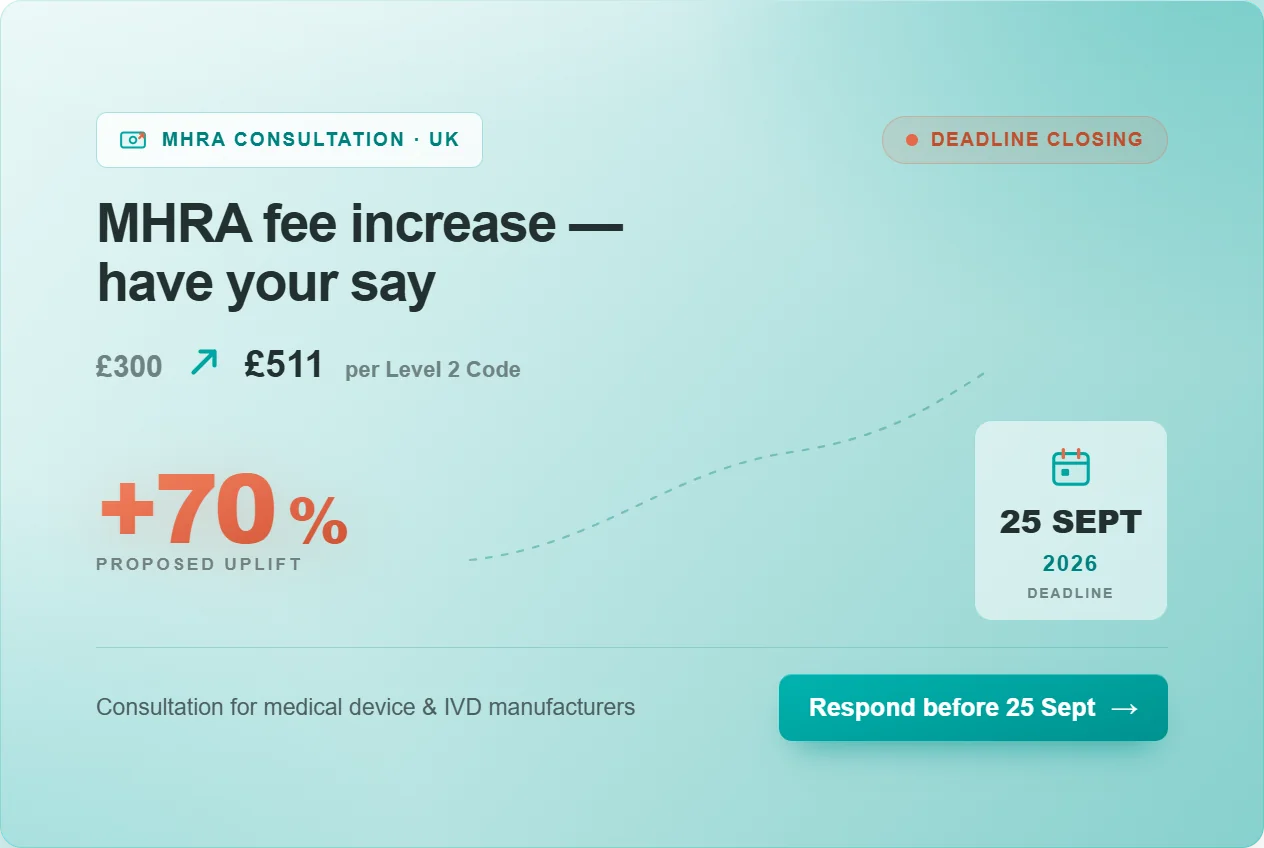
MHRA Consultation 2026: The Fee Increases Coming for Medical Device Manufacturers in 2027
The MHRA has opened a consultation on fee increases from April 2027 — including a proposed 70 % rise in the post-market surveillance fee. Manufacturers have until 25 September to respond.

New EU Study: Where Manufacturers and Authorised Representatives Really Stand on MDR and IVDR
New EU study finds 48% of manufacturers have withdrawn devices from the market. Key MDR/IVDR and AR findings for 2026. Read the numbers now.
Stay Updated
Get the latest regulatory updates and industry insights delivered to your inbox.
Subscribe to Updates