Well-Established Technologies Under the MDR: EU Commission Expands Exemption List
The EU Commission has expanded the WET list under the MDR, easing requirements for certain class II and class III devices.
MedNet EC-REP
Author

In late June 2026, the European Commission published two delegated regulations in the Official Journal of the EU that expand the list of "Well-Established Technologies" (WET) under the Medical Device Regulation (MDR).
Both acts have been in force since 19 July 2026 and are therefore already applicable. Both are dated 20 March 2026, but were only published in the Official Journal around three months later. For delegated acts, the twenty day period before entry into force generally starts running from publication, not from the date the act was adopted.
What Are "Well-Established Technologies"?
According to MDCG 2020-6, WET devices share a common, simple and stable design, a well-known and unremarkable safety record, well-known clinical performance characteristics as an established standard of care, and a long history on the EU market. For selecting the newly added device types, the Commission carried out a wide consultation of the Medical Device Coordination Group (MDCG), as stated in both regulations.
Regulation (EU) 2026/1451: Expanded Exemption From Clinical Investigations
This regulation amends Article 61(6)(b) MDR and expands the list of implantable and class III devices exempted from the obligation to perform a clinical investigation. The list is extensive and covers, newly added devices:
cranial perforators, cranio-blades, catheter passers, patties and strips, magnets for implantable pulse generators, port plugs, stylets and stylet guides, needles, needle holders, forceps, cannulas, atrioseptostomy balloon catheters, catheters coated with anticoagulants, blood bags incorporating anticoagulants, port catheters, introducers, dilators, ventricular drains, feeding tubes, suture pledgets, suture sleeves, suture buttons, gastrostomy buttons, bone tacks, bone wax, bone fillers, bone substitutes, stem centralisers, diaphyseal obturators, radiography markers, fiber ligatures, tubal extraluminal ligation devices, transpalatal distractors, nails, anchors, spinal posterior fixations, textile braids, dental implants, orthodontic devices, dental barriers, dental veneers, suspensory fixations and cinches, reusable surgical instruments, springs for skull enlargement, guidewires, pressure wires, pacing wires and leads, snares, lead caps, fixation and connector tools, endovascular embolisation coils, embolisation particles, cables, shunts, internal defibrillation paddles.
The key point: under recital 5 of the regulation, the obligation to carry out a clinical evaluation under Article 61 MDR remains fully in place for these devices. Only the obligation to perform a clinical investigation is waived. The clinical evaluation, based on sufficient clinical data, must still be planned, conducted and documented.
Context: One Piece of the Wider MDR Reform
The expansion of the WET list sits alongside the Commission's broader MDR reform proposal presented in December 2025, itself part of the Commission's wider simplification agenda. Under that proposal, WET would eventually shift from a list based system to a definition based one.
Conclusion
The expanded WET list reduces the regulatory burden for manufacturers of certain implantable, class III and class IIb devices in two concrete ways: the removal of the clinical investigation requirement for certain device types, and a return to sample based rather than per device technical documentation assessment for certain class IIb implants. The underlying obligation to carry out a clinical evaluation remains in place in every case. Manufacturers with products in the categories listed above should check whether their devices now fall under either of the two new lists, and what that means for their own technical documentation.
Do You Need an EU Authorized Representative?
If regulatory changes like this one affect your EU market access, we're here as your EU-REP. ⇨ Contact us!
Sources
Commission Delegated Regulation (EU) 2026/1451 (full text): eur-lex.europa.eu
Commission Delegated Regulation (EU) 2026/1359 (full text): eur-lex.europa.eu
Context on the broader MDR reform (paraphrased): RAPS Regulatory Focus, 30 June 2026, with commentary from Erik Vollebregt (Axon Lawyers)
Related Articles

IVDR Rule 7: When Is IVD Control Material Class B? (MDCG 2020-16 Rev. 5)
MDCG 2020-16 Rev. 5 clarifies when IVD control material without an assigned value falls under class B, and when another rule applies.
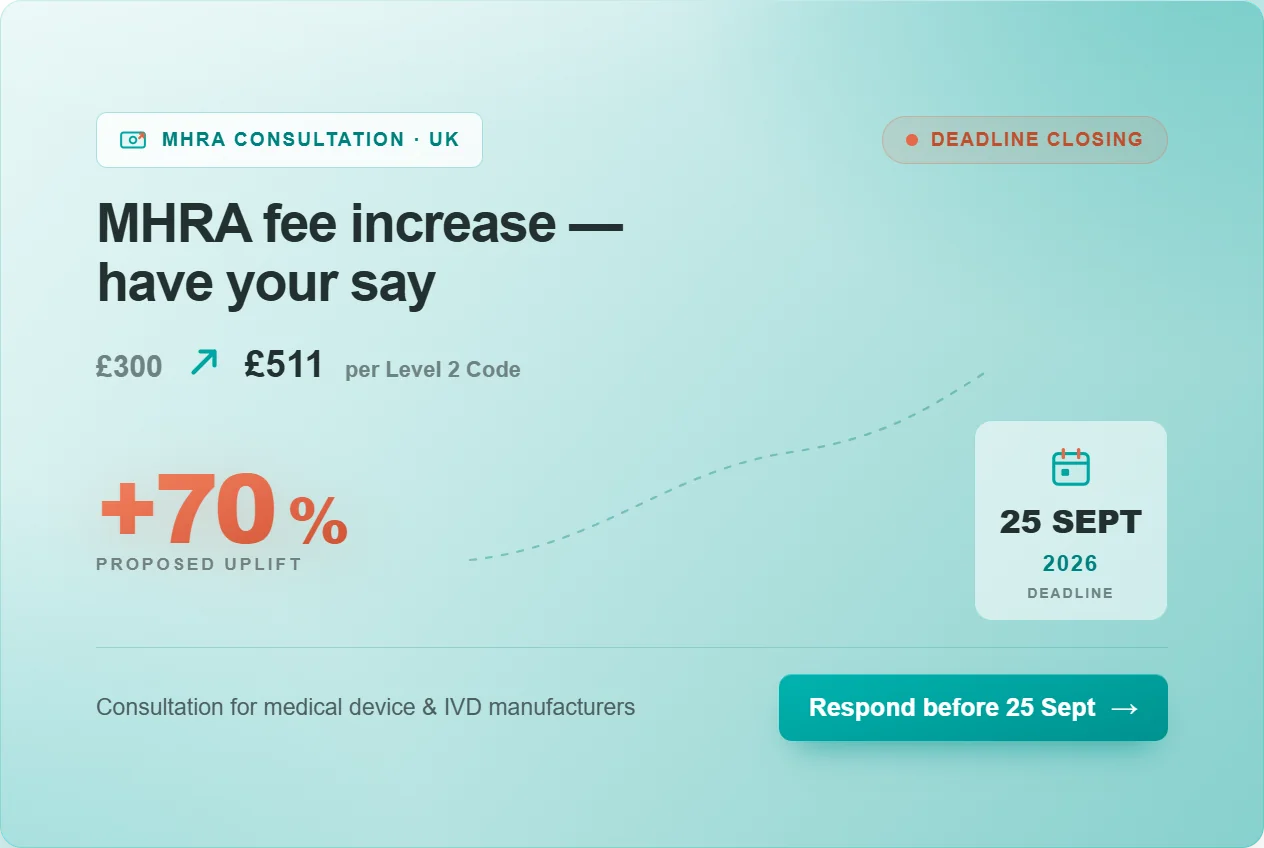
MHRA Consultation 2026: The Fee Increases Coming for Medical Device Manufacturers in 2027
The MHRA has opened a consultation on fee increases from April 2027 — including a proposed 70 % rise in the post-market surveillance fee. Manufacturers have until 25 September to respond.

New EU Study: Where Manufacturers and Authorised Representatives Really Stand on MDR and IVDR
New EU study finds 48% of manufacturers have withdrawn devices from the market. Key MDR/IVDR and AR findings for 2026. Read the numbers now.
Stay Updated
Get the latest regulatory updates and industry insights delivered to your inbox.
Subscribe to Updates